Previous guideWhy Nobody Will Quote Your Driveway Over the Phone
What a concrete driveway actually costs, our indicative ranges by finish, and the things that decide where your job lands inside them.

There is a version of this article written by every concreter in the country and most of them are really an advertisement. So here is the honest one, including the part where we tell you which concrete jobs you genuinely should do yourself and save the money.
Almost every trade around a house forgives a slow learner. Paint dries and you can sand it back. Tiles come up. Timber can be unscrewed and cut again. You can stop at four in the afternoon, look at what you have done, and fix it on Saturday.
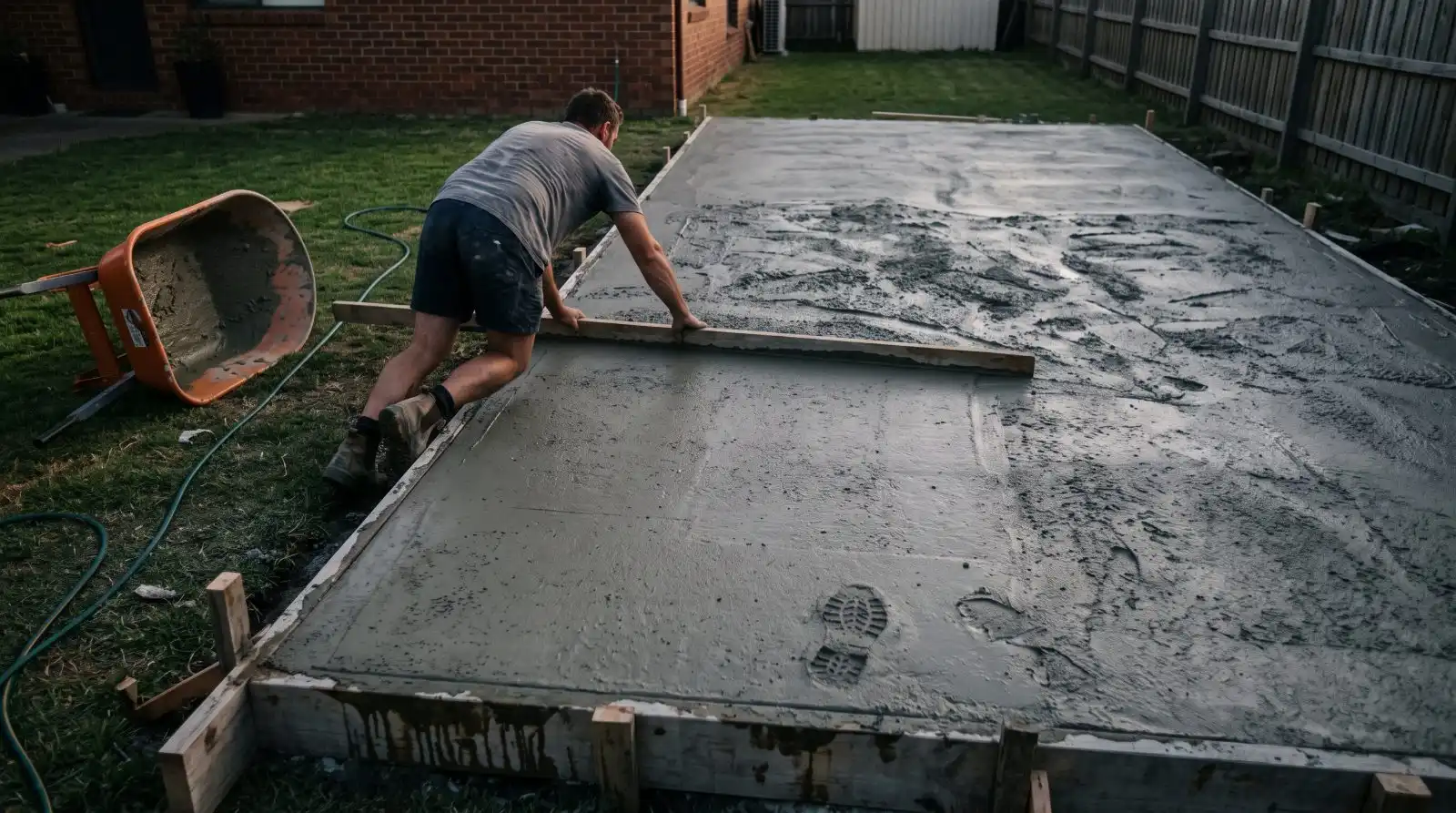
Concrete does none of that. From the moment it is batched it is going off, and the window you have to place it, level it, and finish it is measured in hours and shrinks with heat and wind. A truck arrives with several tonnes of a material that will not wait, and everything you did not think about beforehand has to be solved while it is going hard in front of you.
That is the whole difficulty of this trade, and it is why experience matters more here than in almost any other job on a house. Not because the individual steps are clever, but because there is no time to work anything out.
Not a list of things that could theoretically happen. This is what we get called out to look at.
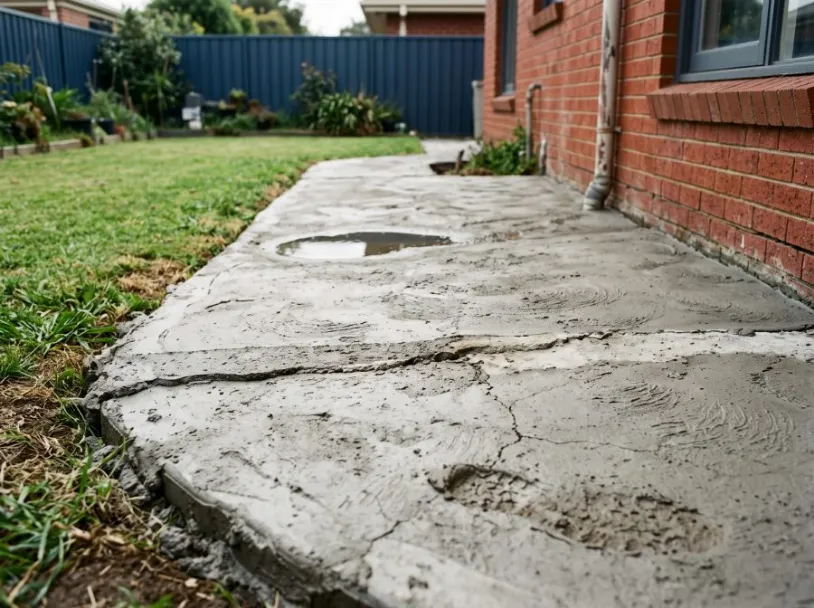
The most common one by a distance and the most expensive. Loose fill looks perfectly flat when you rake it. Under a slab it settles unevenly, and the slab cracks where it loses support. You will not see the mistake for a year or two, and by then it is not fixable, only replaceable.
Concrete is sold by the cubic metre and the difference between what you estimated and what the hole actually takes is not academic. Short, and you have a cold joint across the middle of your slab forever. Over, and you are paying to dispose of it in the twenty minutes before it goes off in the drum.
A truck chutes about three metres. If the pour is out the back, the concrete gets there by wheelbarrow, and a cubic metre is roughly twenty barrow loads. Two people and a wet Saturday is how a small back yard slab becomes the worst day of the year.
Reinforcement does nothing lying on the base. It has to sit up in the slab on bar chairs, and it is very easy to walk it down into the sub-base while you are placing concrete around it. A mesh you cannot see is a mesh that is not working.
Trowelling a surface before the bleed water has gone seals water into it and gives you a slab that dusts and flakes. Leave it too long and you cannot close it at all. The window between those two is not marked and it moves with the weather.
Concrete shrinks as it cures and it will crack. Control joints decide whether that crack happens in a straight sawn line where you put it or across the middle where it feels like a fault. Cutting them is a same-day job, and curing properly is another few days of attention after the exciting part is over.
We would rather you did the small jobs than paid us for them. This is roughly where the line sits.
A bad paint job costs you a weekend and some paint. A bad tiling job costs you the tiles. A bad slab costs you the slab, the removal of the slab, and the new slab, and the removal is often the most expensive line of the three because it is a day of breaking out and carting away material that is now rubbish.
That asymmetry is the real argument, and it is worth being clear that it is an argument about risk rather than about talent. A careful person with time and a small pour will very likely be fine. The same person on a driveway, on a hot day, with a truck waiting and no one to help finish, is not making a skill mistake. They are taking a bet with the odds against them and no way to fold.
The reason a crew makes it look easy is not that the steps are simple. It is that four people who have done it a thousand times are all doing their part at once while the clock runs.
Then do it on the smallest thing you own. Pour a stepping stone before you pour a path, and pour a path before you go near a driveway. Every mistake in this article is much cheaper to make in a wheelbarrow than in a truckload.
Order more than you think, by a margin. Have more people than you think you need, because finishing is where hands run out. Start early on a cool day, have the formwork and the base done and checked the day before, and have everything you need on site before the truck is called, because you will not be leaving to get it.
And if it is a driveway, or it is a structural slab, or it is behind the house, get a price. It is free, it takes twenty minutes, and worst case you find out the job was smaller than you feared and you do it yourself with better information.
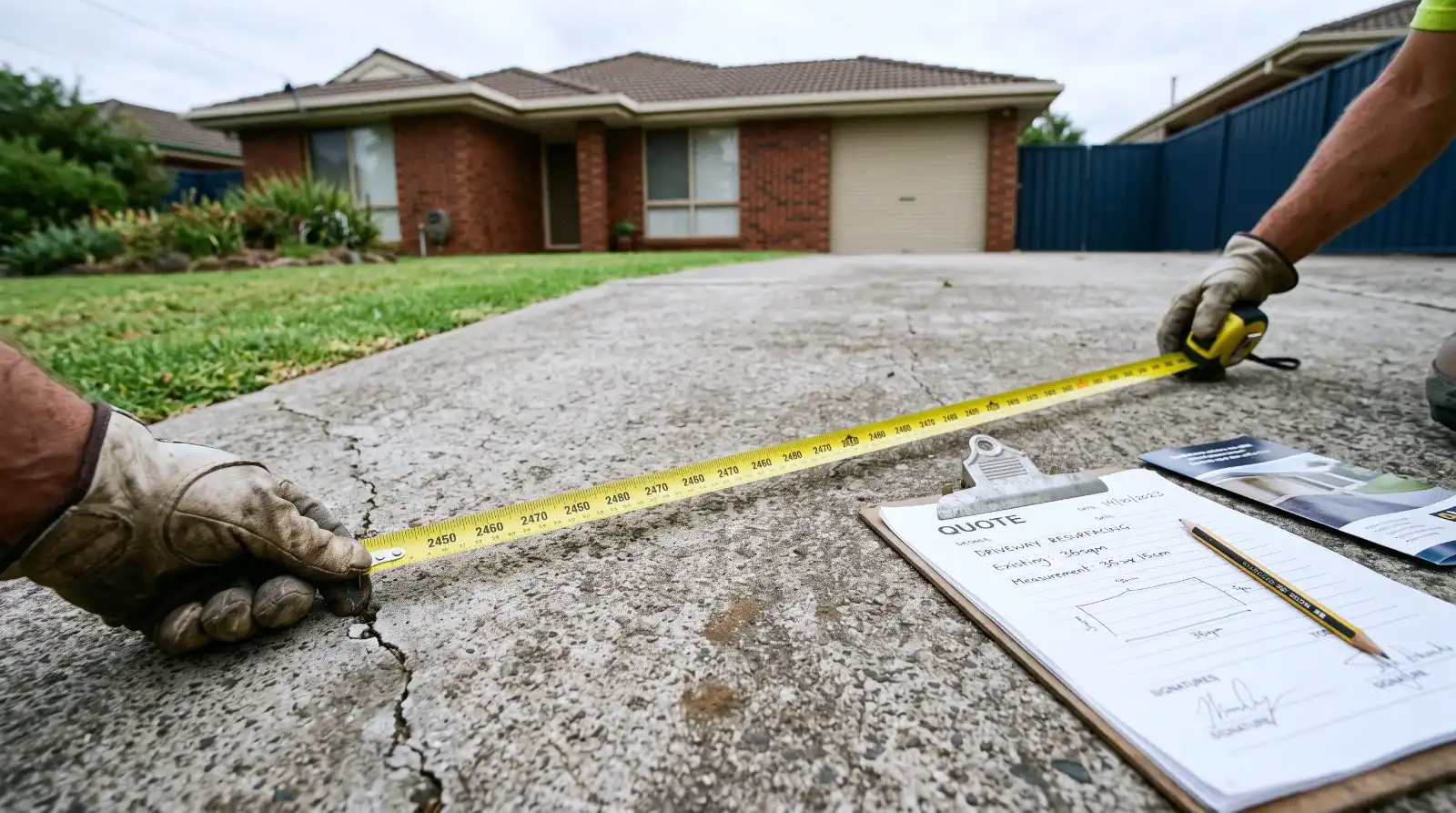
Send us the size and where it is. We will come out, measure the real thing and put a number in writing.
Get a Priceor call (03) 6724 3698Everything else we have written down, in the same spirit as this one. How the job actually works, what it costs, and where people get caught out.
All guidesSend the size and where it is, or ring us. We come out and measure it properly, free either way.
Would rather talk it through? (03) 6724 3698, or send the details through the contact page.
The individual steps are learnable in an afternoon. Doing all of them correctly, in the right order, in the time concrete gives you, is the hard part. That is why the same person can succeed on a stepping stone and come unstuck on a driveway.
Not sensibly. A modest single driveway is several cubic metres, which is well over a hundred bags, and every batch you mix separately is another chance for the colour, the strength and the finish to differ. Bagged mix is for small pours.
Length by width by thickness in metres gives you cubic metres, then add for the base being uneven, which it always is. Getting this wrong in either direction is expensive, so if you are ordering a truck it is worth having someone check the number before you place the order.
The base. It is the part nobody watches, it is finished before anything interesting happens, and it is the part that decides whether the slab cracks. Levelled is not the same as compacted.
Yes, and we would rather look at it early than after another winter. Sometimes the answer is a repair, sometimes it is cutting out a section, and sometimes it is that the slab has to come out. We will tell you which one it is.
One call and we come out, measure the real thing and put a price in writing. It costs nothing and there is no salesman in it.
One call. We measure it and put a fixed price in writing. Costs nothing.
Would rather type it out? Send the details instead