
Measured and Quoted on Site
Not off a photo. We come out, look at the ground and the access, and price the actual job.
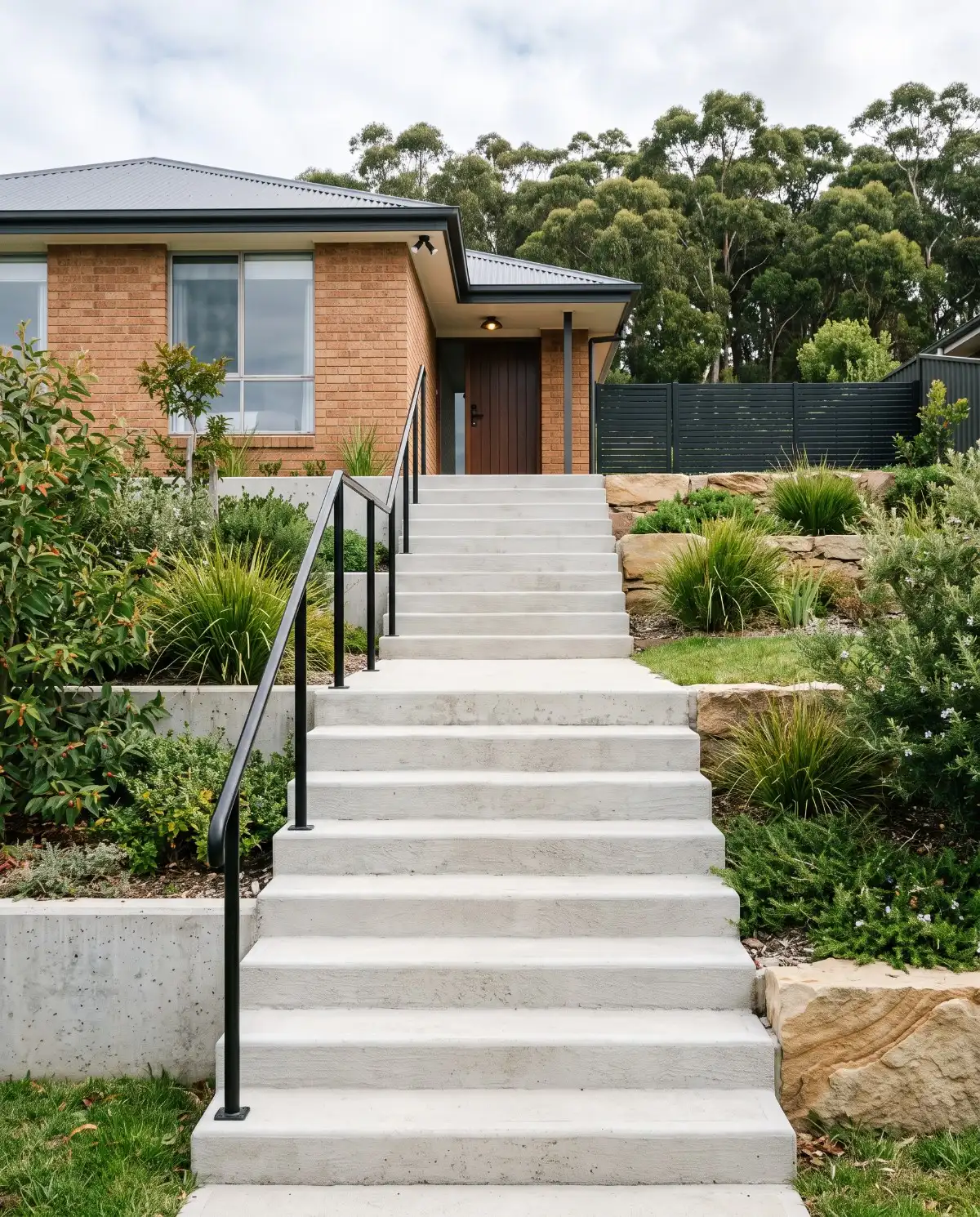
Concrete steps are the one thing we build in Launceston that can actually hurt somebody. Everything here comes down to two rules: every riser the same height, and grip on every tread. Get those wrong and no amount of finish rescues it.
Not off a photo. We come out, look at the ground and the access, and price the actual job.
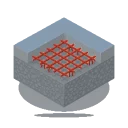
Excavation, a compacted base and reinforcement to spec, the half that decides how long it lasts.

One written price for the whole job, not a rate per square metre, and the site is left clean.
One step out by fifteen millimetres is the step people trip on, because your foot goes where the last one taught it to. It is the most common fault we are called to look at and it cannot be fixed without breaking them out.
Measure from the bottom level to the top level, divide into equal risers, and that decides how many steps you get. Not the other way around.
The temptation is to absorb the leftover in the top or bottom step. That is exactly the step someone catches a toe on.
Australian residential stair rules put risers in that band and goings at 250mm or more. Within it, lower and deeper is more comfortable outdoors.
A deep tread lets a whole foot land. Shallow treads on outdoor steps are where people go down, particularly carrying something.
The arithmetic happens on paper first. Once the formwork is up, the flight is what it is.
A wet concrete step in a Launceston winter is the most slippery surface on most properties. This is not a place to choose a finish because it photographs well.
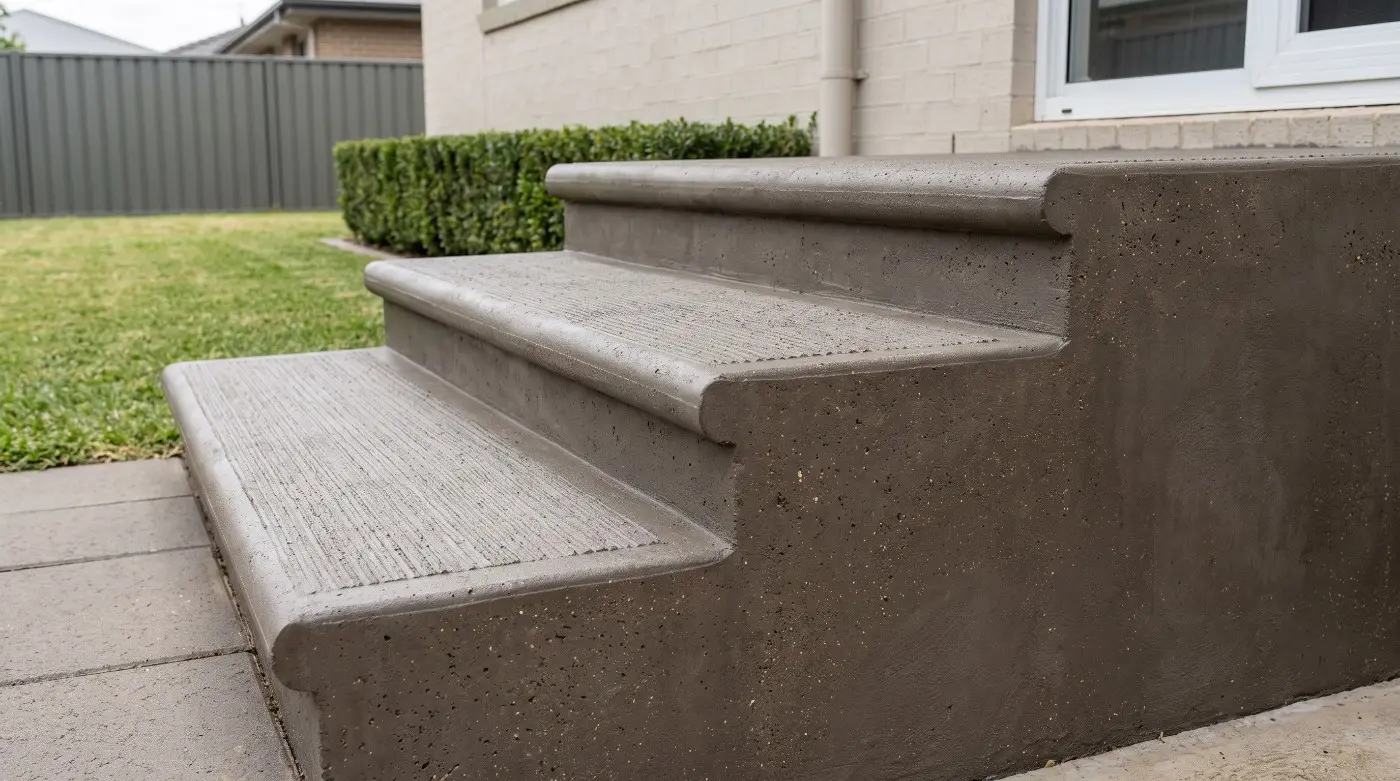
Run across the step rather than along it, so the texture works against the direction people walk. The default, and the safest.
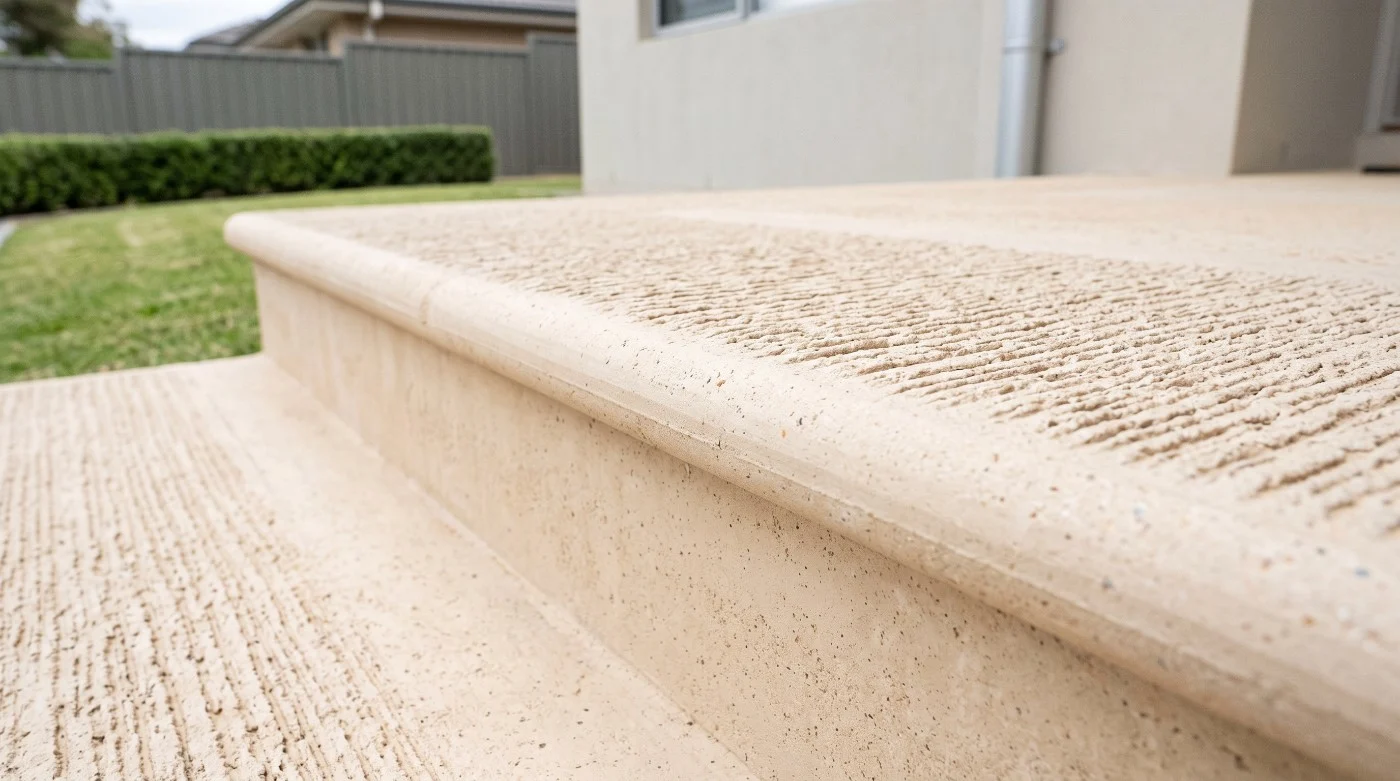
Stone proud of the cement grips well and looks better than a broom. It is the usual choice on a front entry.
Both are beautiful and both are hazards on a wet tread. If it is outdoors and it is a step, it gets grip.
A rounded front edge is kinder to shins and to bare feet, and it chips far less than a sharp arris.
A different colour or texture on the front edge makes the step visible at dusk. Worth doing where anyone older uses them.
Grip is decided at the pour, not afterwards. Tell us where the steps go and how wet they get.
The same rules apply to every set of concrete stairs we build. What changes is the height, the width and how much the flight has to turn.
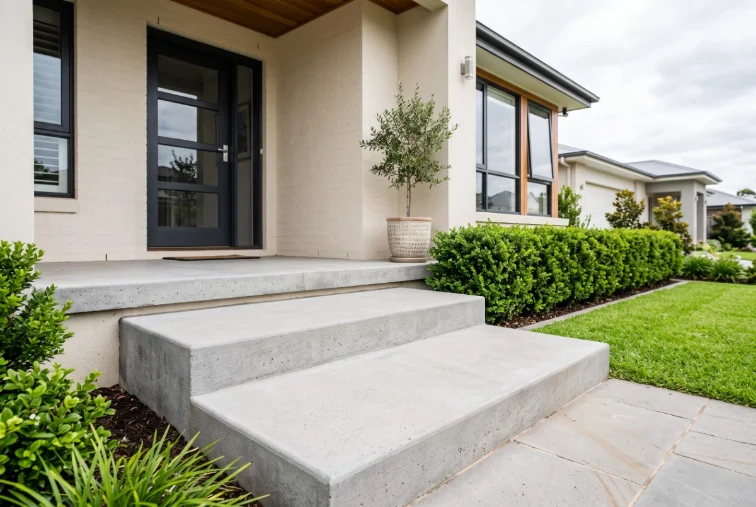
Wide and shallow, often only two or three, doubling as a landing at the door. The most-seen concrete on the house.
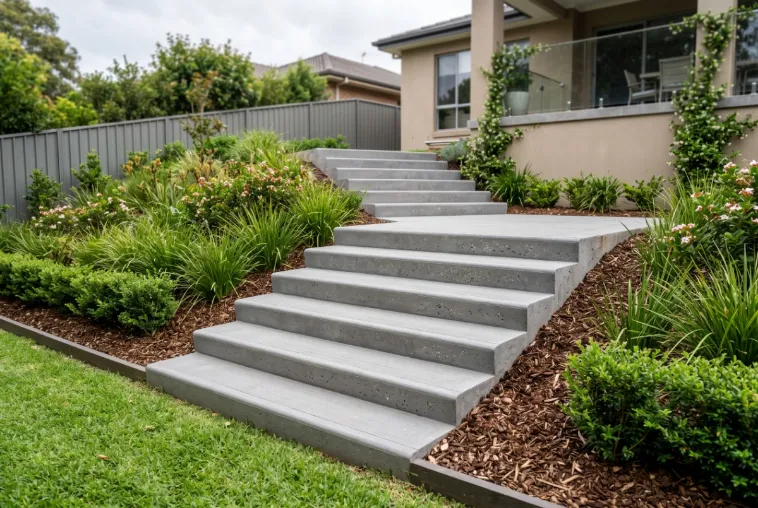
Climbing a slope with a landing partway. Launceston is built on hills, so this is the one we do most.
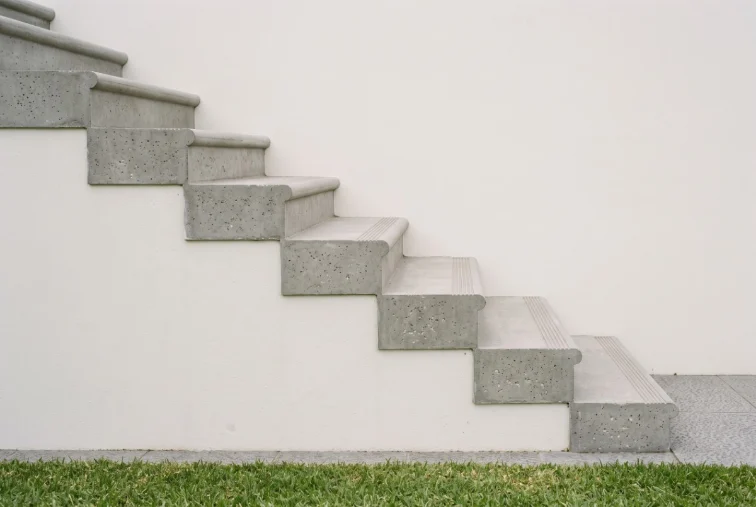
The whole job in one photograph. Every step the same, which is what you feel rather than see.
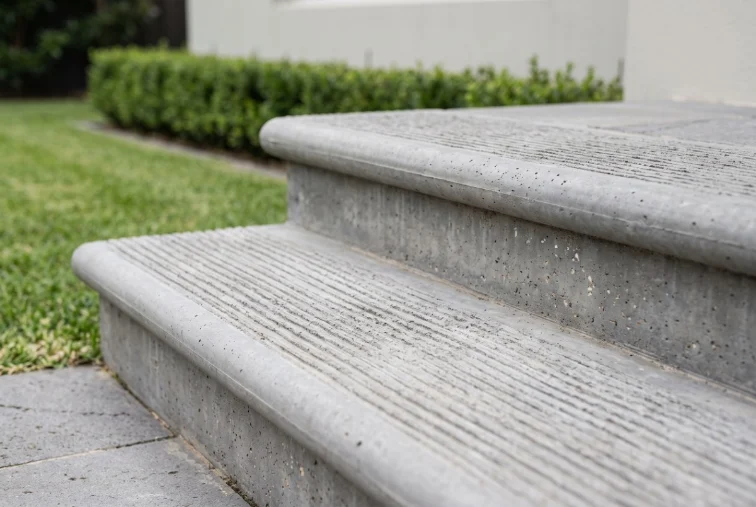
Broom texture across the tread, bullnosed front edge. The safety half of the specification.
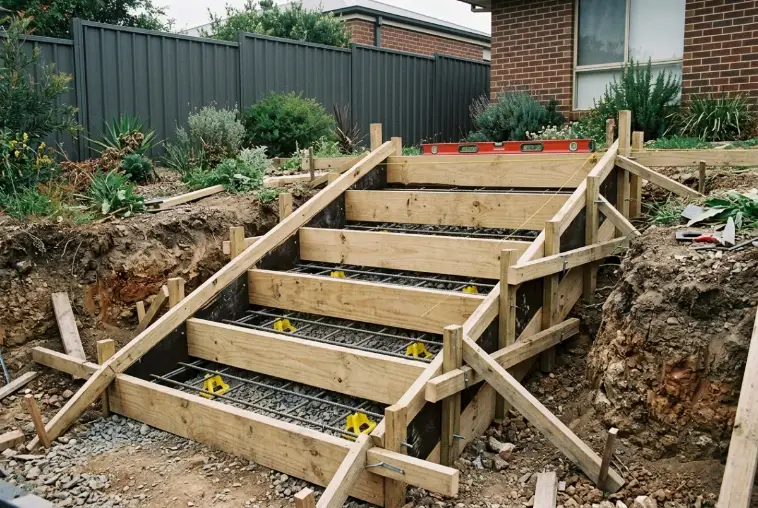
Boxed up on a cut bank with steel through it. The arithmetic is already finished by this point.
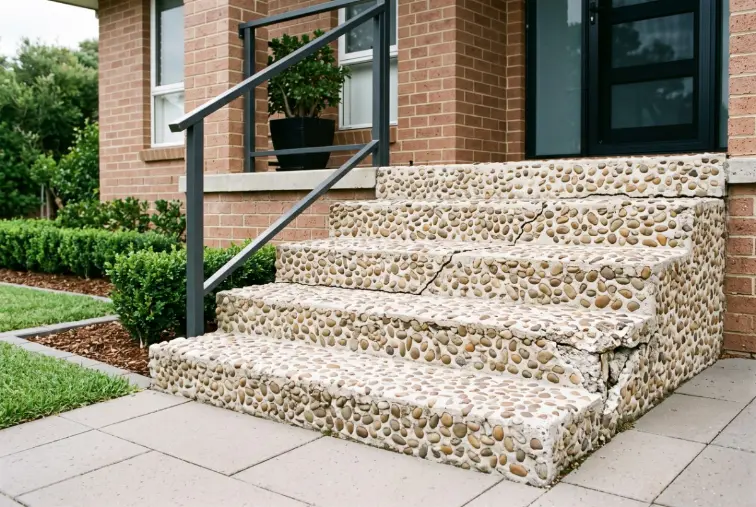
Uneven risers, worn treads and moss. Almost every set we replace failed on consistency rather than on strength.
Steps are arithmetic before they are concrete. This is roughly how a rise divides. Read across.
Concrete stairs stop being just concrete once they climb far enough. Beyond a certain point a flight has requirements attached, and they exist for good reasons.
Steps on a slope often need a wall or a footing under them. We will tell you which yours needs before you are quoted.
A flight of steps is a small job with no room for approximation, and most of the skill is in the first hour.
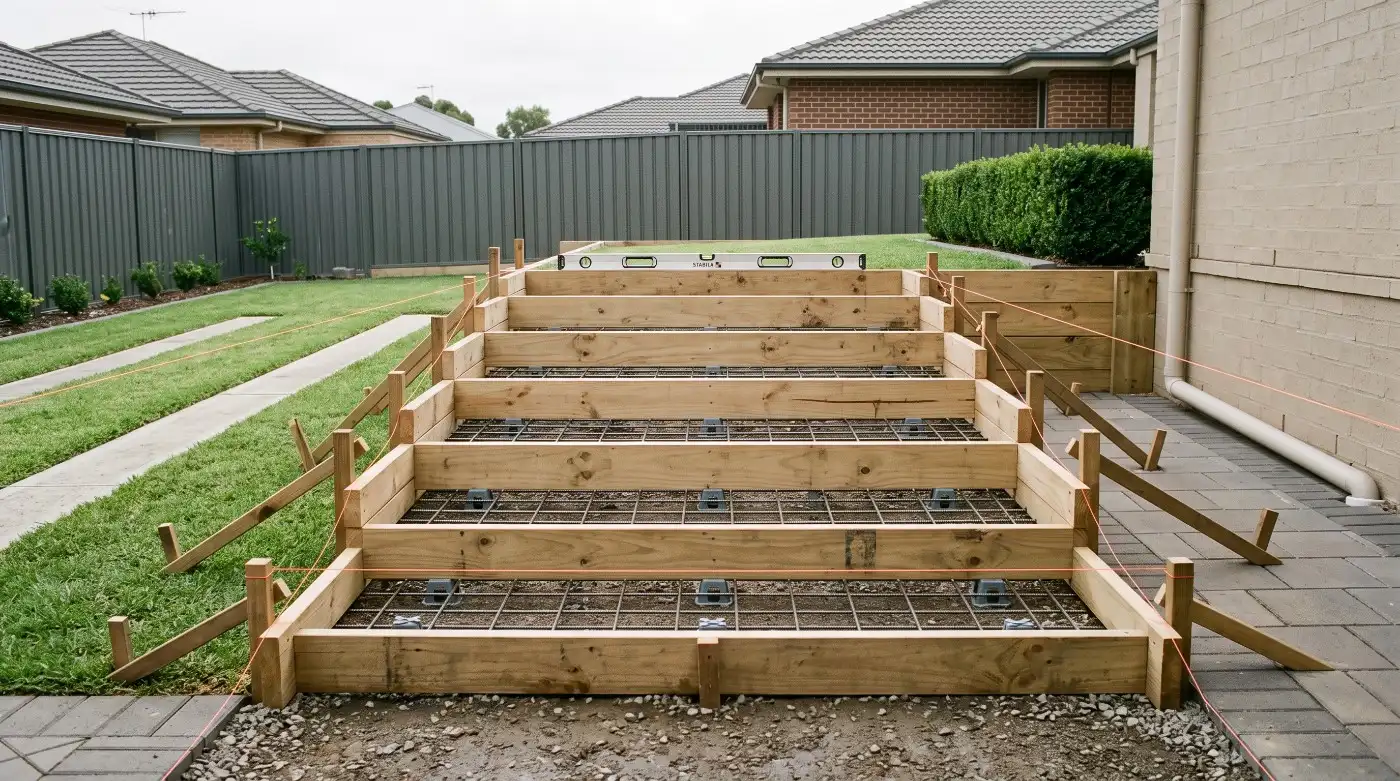
Bottom level to top level, accurately. Everything else on the job comes out of this one number, so it is worth getting right.
The arithmetic, done on paper before anything is cut. This is where an uneven flight is prevented or created.
The bank cut back to the profile and a compacted base under the flight, because steps settle the same way anything else does.
Formwork built to the set out with riser boards at the calculated spacings, and steel through the flight tying it together.
Poured from the bottom up, each tread finished for grip and each nose formed, then cured before the formwork comes off.
Steps cost more per square metre than almost anything else we pour, because they are nearly all formwork and very little area.
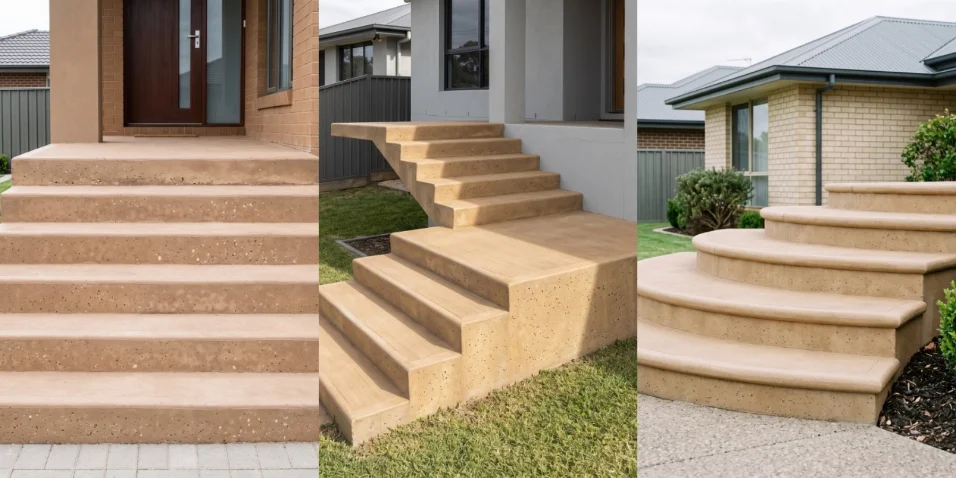
Straight, turning and curved, left to right. The shape moves the price more than the area does.
The shape is set by the ground and the doorway it has to meet. A straight run is one set of forms; a turn adds a landing and a second flight; a curve is set out tread by tread.
The main driver. Each step is its own piece of formwork, so a flight of ten costs a great deal more than a flight of three.
Width adds concrete and finishing but not much formwork, so wider steps are better value per square metre than more of them.
A landing is effectively a small slab in the middle of a flight, and it is priced as one.
Cast-in fixings are cheap on the day. Core-drilling into finished steps afterwards is a separate visit.
Old steps out and carted away. On a tight site with no machine access this is hand work and it is the line most quotes underestimate.
Send a photo of the slope and tell us the total height you need to climb. That one number sets the whole flight. The measure is free either way.
Would rather talk it through? (03) 6724 3698, or send the details through the contact page.
Plus the wider Launceston area.
Australian residential stair rules put risers between about 115 and 190 millimetres with a going of 250 millimetres or more. Outdoors, lower and deeper is more comfortable, around 150 millimetres works well. The real number comes from dividing your total rise into equal parts, which is why the total height is the first thing we measure.
Because your foot goes where the previous step taught it to. One riser out by fifteen millimetres is the one people trip on, and it is the most common fault in the sets we are asked to replace. It also cannot be corrected afterwards without breaking the steps out.
Generally once the flight climbs more than about a metre, and it is worth having before that if anyone older or less steady uses them. If there is an open edge with a drop beside the steps that becomes a barrier requirement, which is stricter. Fixings are much cheaper cast in than core-drilled later.
A broom finish run across the tread, or exposed aggregate. Both grip well when wet. Honed and polished concrete are hazards on an outdoor step regardless of how good they look, and we will not put them on a tread that gets rained on.
Chips, worn nosings and surface damage can often be repaired. Uneven risers cannot, the fault is in the geometry rather than the surface, so the fix is to rebuild them. We will tell you honestly which one you have rather than patching something that should be replaced.
About a day for careful foot traffic once the formwork is off, and a week before anything heavy. Full strength is twenty-eight days, and cold weather slows it, which matters through a Launceston winter.
One call and we come out, measure the real thing and put a price in writing. It costs nothing and there is no salesman in it.
One call. We measure it and put a fixed price in writing. Costs nothing.
Would rather type it out? Send the details instead