
Measured and Quoted on Site
Not off a photo. We come out, look at the ground and the access, and price the actual job.
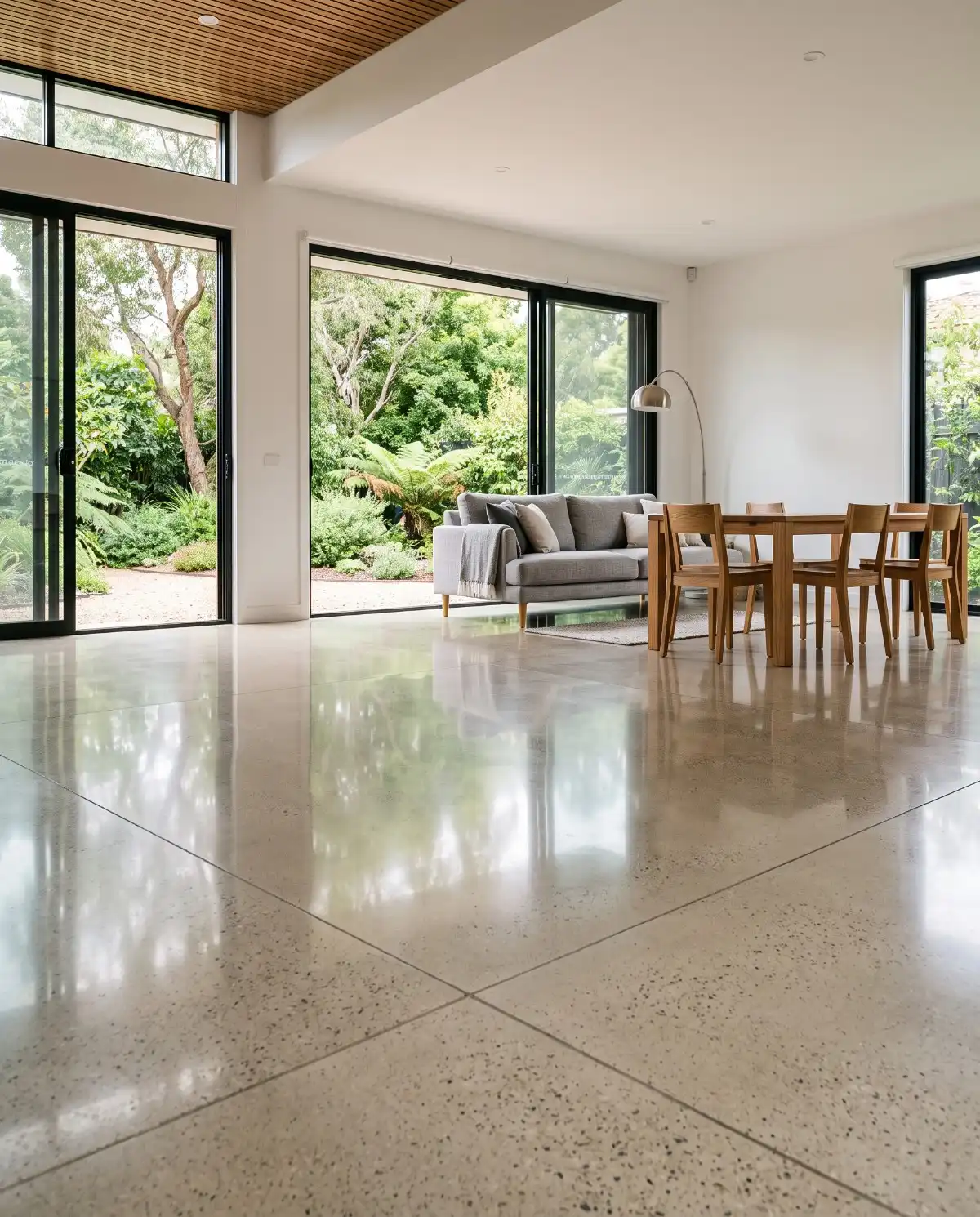
Polished concrete floors are an indoor finish, and in Launceston they turn up in extensions and shed conversions more than anywhere else. It is the slab your house already sits on, ground and sealed until it reflects the room, which is why it is the one finish that can cost you nothing in materials you have not already paid for.
Not off a photo. We come out, look at the ground and the access, and price the actual job.
Excavation, a compacted base and reinforcement to spec, the half that decides how long it lasts.

One written price for the whole job, not a rate per square metre, and the site is left clean.
Everything else about a polished floor is detail. This is the choice, it is made before we start, and it cannot be undone afterwards, grinding deeper is possible, going back is not.
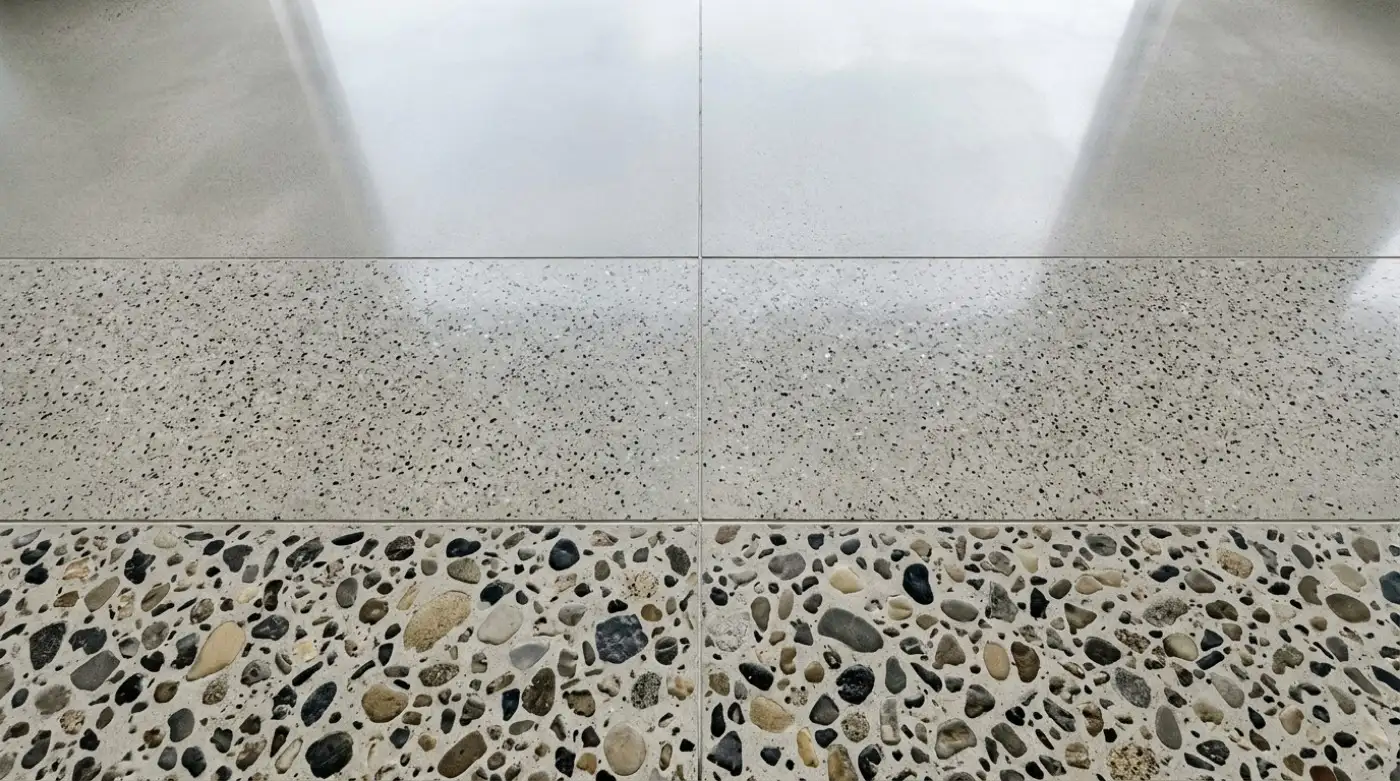
Barely cut. The cement surface is polished with almost no stone showing, so the floor reads as a soft even tone. The calmest of the three.
Ground just past the cement to reveal the sand and small chips. Evenly speckled, the most popular choice, and the most forgiving of an ordinary slab.
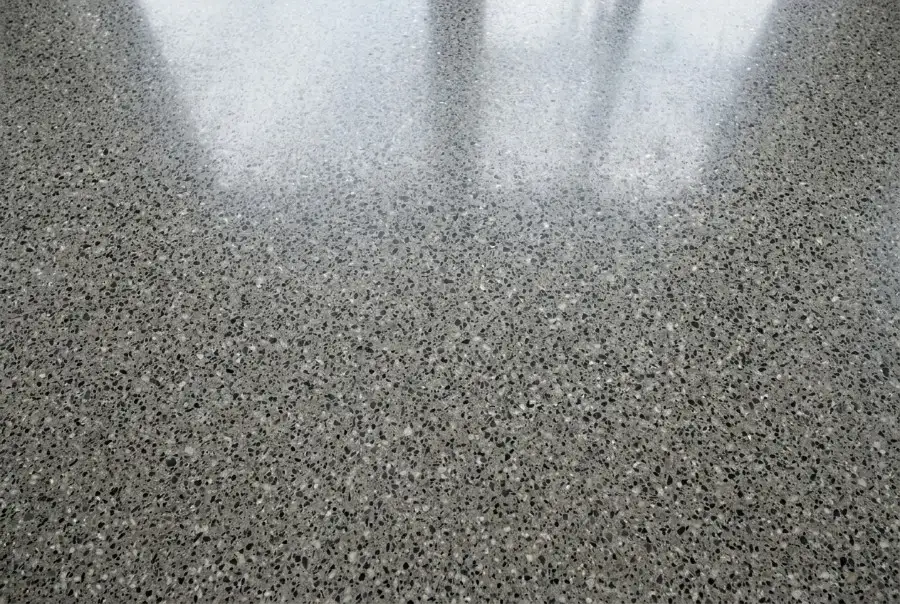
Cut deeper to reach the large aggregate, which reads like terrazzo. Spectacular, and it depends entirely on what stone is in your slab.
On a new pour we choose the stone. On an existing slab you get whatever the builder ordered, and we core a test patch before promising anything.
This is the argument for polished concrete floors that nobody makes properly. If your house sits on a slab, the floor is already there and already paid for. Everything else is a covering over the top of it.
Lift the carpet or the tiles and there is a concrete floor under them. If it is sound and flat enough, it can be ground and sealed instead of recovered.
Best case. The mix, the stone and the flatness are all specified up front, and the slab is poured knowing it will be the finished floor.
Tile glue, old adhesive, patches, plumbing trenches and previous repairs all show once you grind. We test before we quote, not after.
A slab that dips cannot be ground evenly to full stone, the high spots cut deeper than the low ones. Sometimes salt and pepper is the honest answer.
Concrete holds heat, so polished concrete floors over in-slab heating are among the most comfortable floors you can have in a Tasmanian winter.
Send us a photo of the slab you have and we will tell you whether it will polish, before anyone comes out.
The same finish reads differently depending on the room, the light and how much stone you let through.
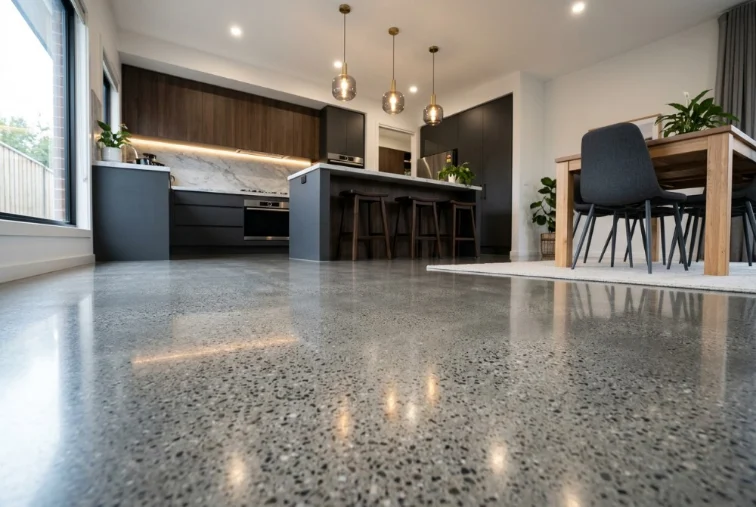
Where it earns its keep. Nothing to catch crumbs, nothing to lift at the edges, and a spill is a wipe rather than a problem.
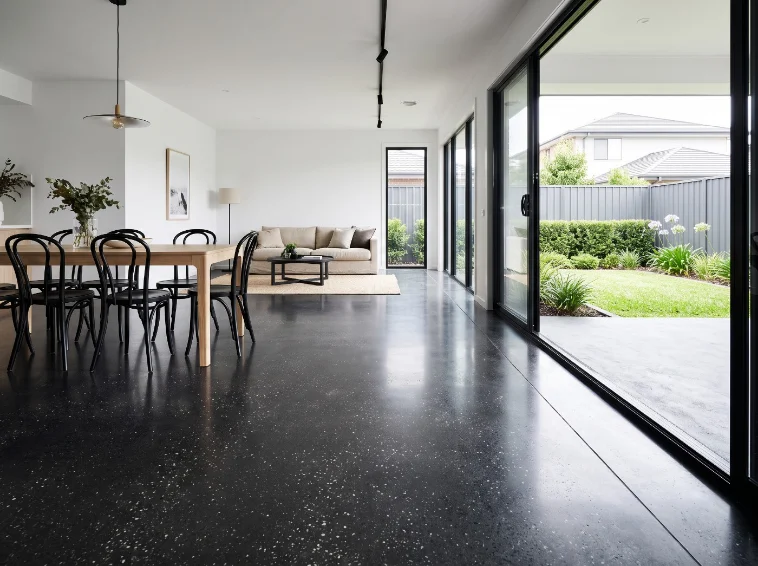
One continuous surface with no thresholds, no joins and no change of material between spaces.
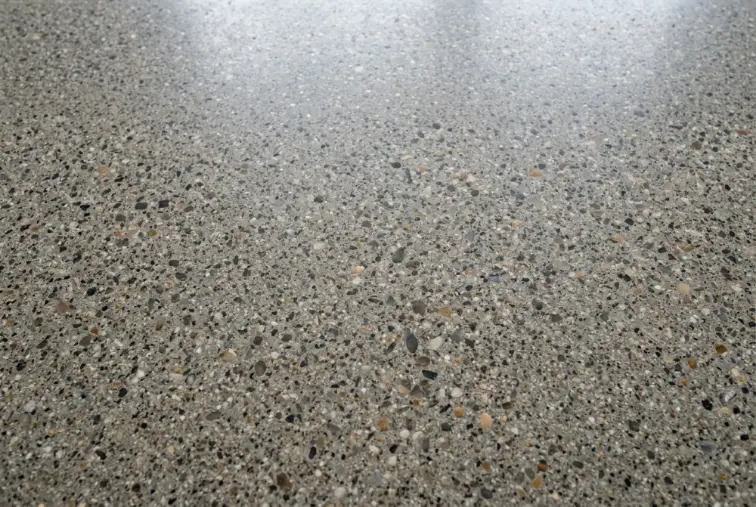
The most popular exposure. Fine chips evenly through a pale ground, and forgiving of a slab that was never meant to be seen.
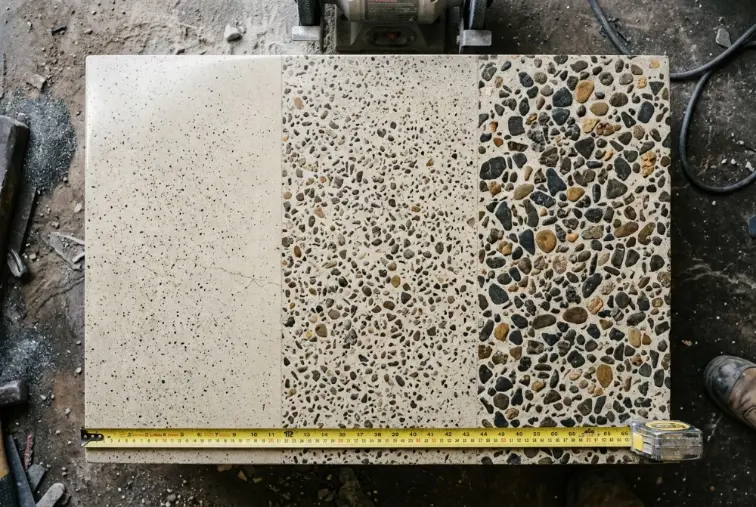
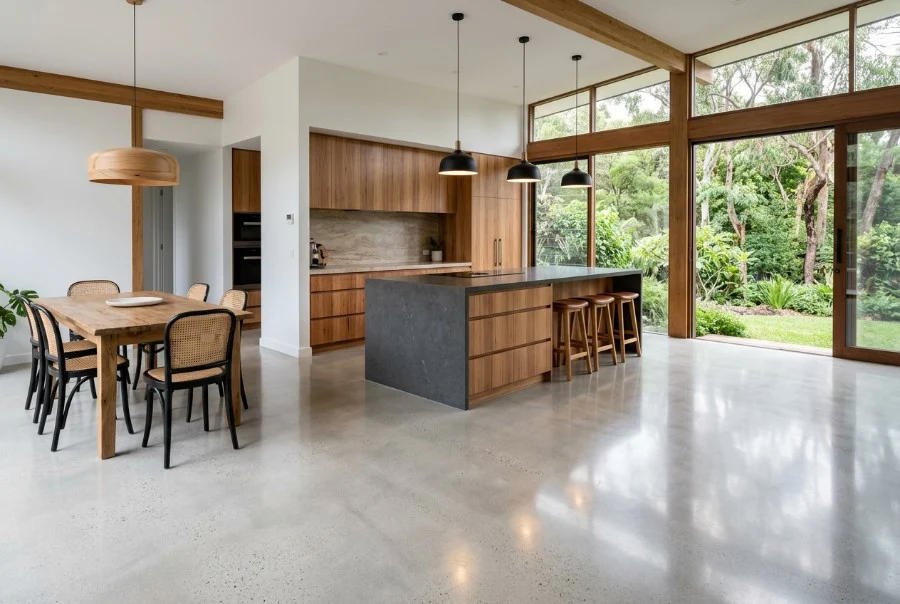
Cream, salt and pepper, and full stone on one slab. Worth looking at before you decide, because the difference is larger than people expect.
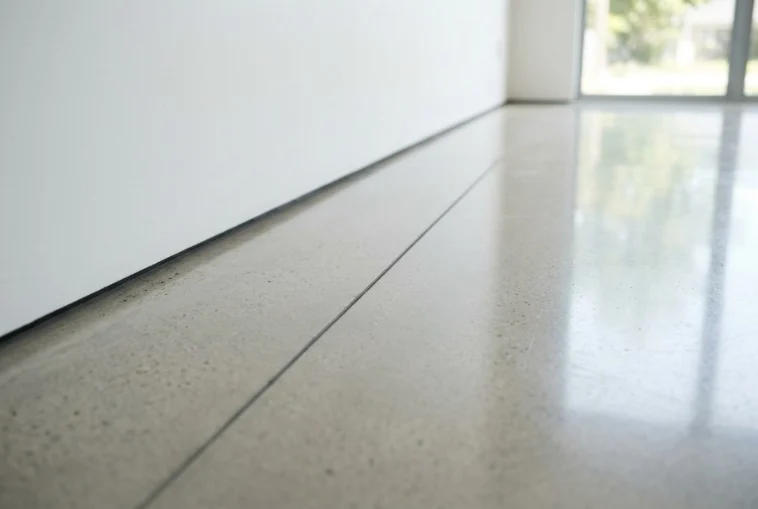
Where the floor meets a wall. A shadow line rather than a skirting keeps the surface reading as one plane.
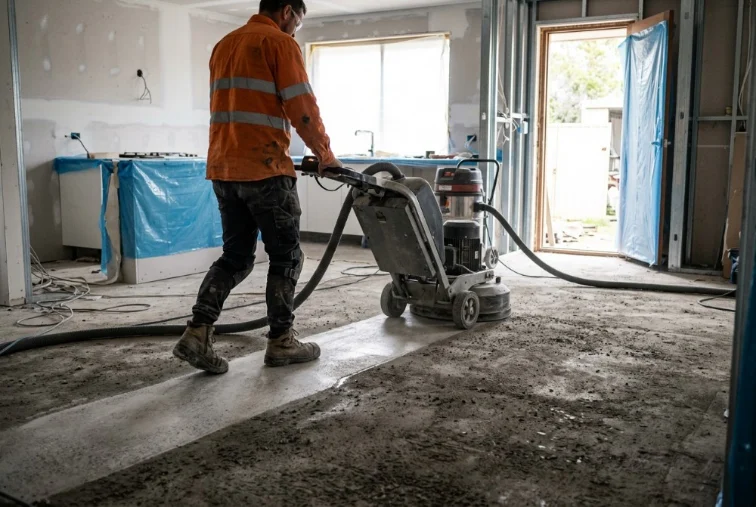
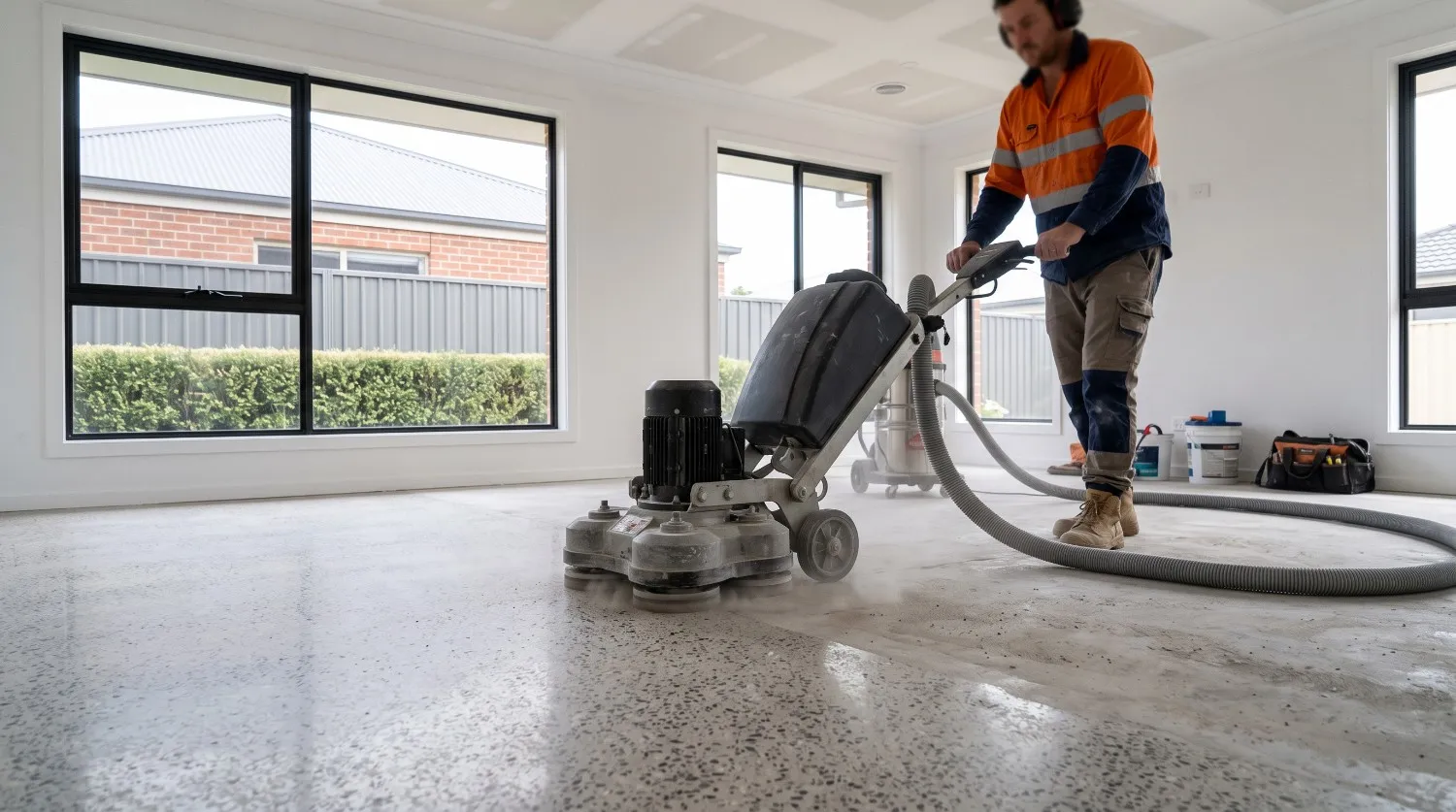
What the process actually looks like. Dust-extracted, and done before the skirting and the kitchen go in.
Ask at the measure and we will show you the real thing before you choose, because a polished floor looks different under a room's own light.
Three names, sold interchangeably, meaning three different amounts of work and three different prices. Read across.
It is a multi-day job with heavy machines and a lot of dust extraction, and it happens before the skirting, the kitchen and the paint.
A small test patch tells us what stone is in there and how flat it is. On an existing slab this is the step that decides what we can honestly promise.
Coarse diamonds cut to the exposure you chose. This is the loud, dusty stage and it is where the floor is decided.
Pinholes and small imperfections filled, then a chemical densifier hardens the surface from within so it takes a polish and resists wear.
Progressively finer diamonds, pass after pass, until the sheen you asked for. More passes is more gloss and more cost.
A penetrating sealer rather than a coating, so nothing sits on top to scratch. Then it is protected while the rest of the build finishes.
Polished concrete is very low maintenance and it is not no maintenance. Here is the honest version before you commit the whole floor to it.
Ask at the measure and we will show you a finished floor and what it looks like after a few years.
Installed, per square metre. Grind and seal and a mechanically polished floor are different processes at different money.
Worked examples at real sizes, so you can see roughly where your job sits before you call. These are indicative ranges only. Final pricing depends on site conditions and finish requirements, which is what the free measure settles.
 80m² Living Floor, Grind and Seal80m² at our polished: grind and seal rate80m² Living Floor, Mechanically Polished80m² at our polished: mechanical rate30m² Room, Mechanically Polished30m² at our polished: mechanical rate
The rates above are the starting point. Polished varies more than any other finish we do, because so much depends on a slab that is already there.
A new pour specified for polishing is straightforward. An existing slab under tiles and glue is an unknown until we test it.
Carpet is easy. Tile glue, vinyl adhesive and old levelling compound are slow, and removing them is often the biggest line on the quote.
Cream polish is fewer passes than full stone exposure. Every extra pass is machine time, and machine time is the cost.
The sheen level is decided by how far through the grits we go. A satin floor and a mirror floor are different numbers of passes.
Machines are efficient in open rooms and slow in hallways, around islands and in anything they cannot turn in. Hand work at the edges is real time.
Cracks, trenches and old patches have to be dealt with, and how visible they end up is a conversation we would rather have before than after.
Tell us the rough floor area and whether the slab is new, existing, or under something you want lifted. The measure and the written price are free.
Would rather talk it through? (03) 6724 3698, or send the details through the contact page.
Plus the wider Launceston area.
Usually yes, and it is one of the best reasons to consider it. If the slab is sound and flat enough to take a few millimetres off, it can be ground and sealed rather than covered. We grind a test patch first, because tile glue, old patches and plumbing trenches all show once you start and we would rather find them before you commit.
How far the grinding goes. Honed stops at a soft matte sheen and is the outdoor finish. Polished continues through finer and finer diamonds to a genuine mirror, and it belongs indoors. It is genuinely slippery outside when wet.
It takes the temperature of the room, so in a Tasmanian winter it is cold underfoot unless there is heating in the slab. With hydronic or in-slab electric heating it is the opposite. Concrete holds heat well and it is one of the most comfortable floors you can have.
Indoors and dry, no more than polished timber or tile. Wet, yes, which is why it is an indoor floor and why we do not recommend it outside or in a wet area without a different finish.
No. Grind and seal is concrete ground once or twice and then given a topical coating to make it shine. It is cheaper, it can scratch, and the coating eventually needs redoing. True polished concrete has nothing on top, the sheen is the stone itself. If one quote is far cheaper than the others, this is usually the difference.
The slab moves like any other, so control joints and existing cracks are part of the conversation. Cracks can be filled and made a feature or made discreet, but they cannot be made invisible. Anyone promising a flawless floor over an old slab has not looked at it.
One call and we come out, measure the real thing and put a price in writing. It costs nothing and there is no salesman in it.
One call. We measure it and put a fixed price in writing. Costs nothing.
Would rather type it out? Send the details instead