A Line Hose Needs About 600mm
It is roughly 75 to 125mm across and it needs room for someone to walk beside it. If a person fits down the side, the hose does too.
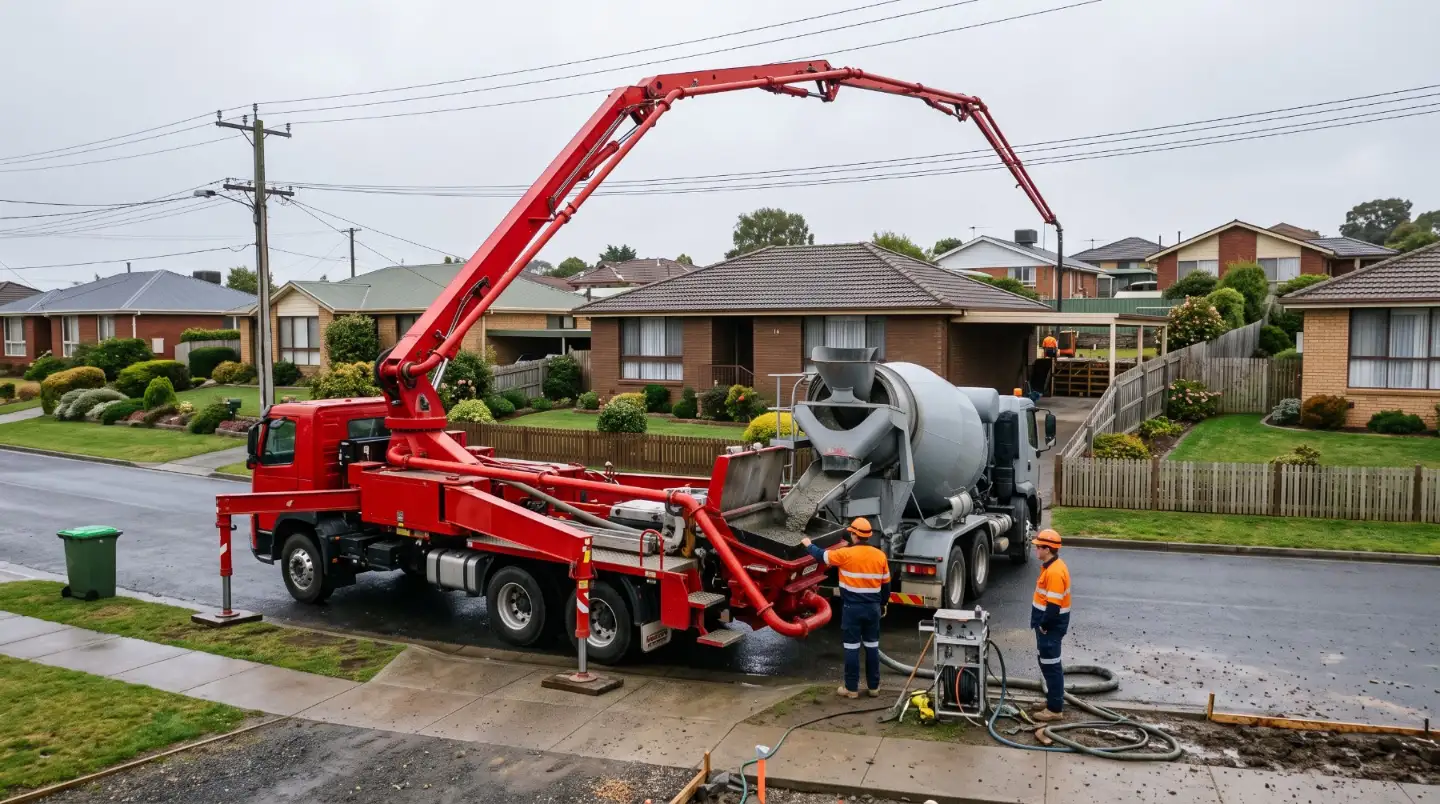
If the truck cannot reach the pour, the concrete still has to get there, and on a Launceston block that is usually the whole problem. A pump moves it over the house, down the side or across the yard, and it turns a job that would take a day of barrows into a couple of hours.
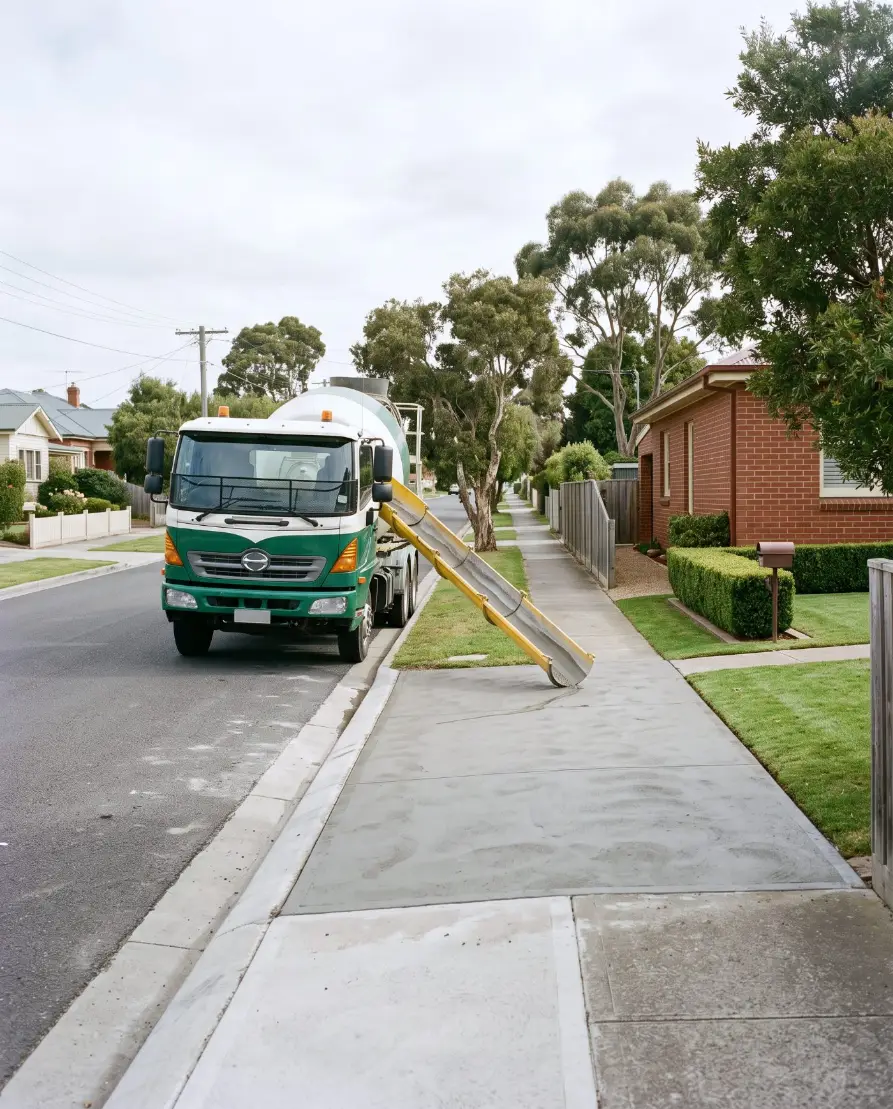
An agitator truck can chute concrete about three metres from where it parks. That covers a front driveway and almost nothing else.
A back yard slab, a shed at the rear boundary, an alfresco off the living room. All of them sit beyond where a truck can stand.
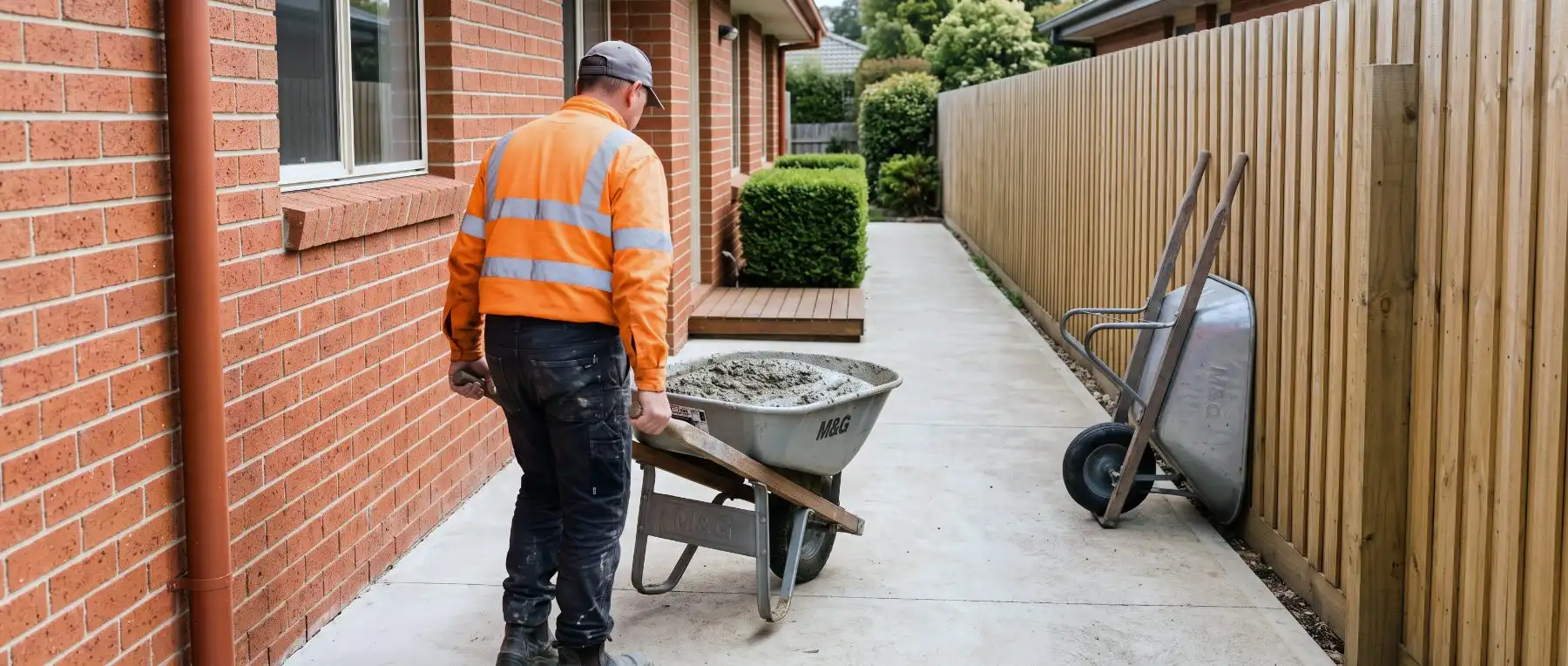
Barrows do not climb, and taking a full one down a slope is how people get hurt on a job that should have been straightforward.
From the truck at the kerb, through a hose, to exactly where it is going. That is the entire idea and everything below is about which machine does it.
If the truck can reach it, we will chute it and there is no extra line on your quote. We check that first, every time.
We would rather tell you to skip it than take the money for a machine you did not need. This is roughly how it splits.
Almost every residential job in Launceston goes on a line pump. The boom is for when there is something in the way that a hose on the ground cannot get past.
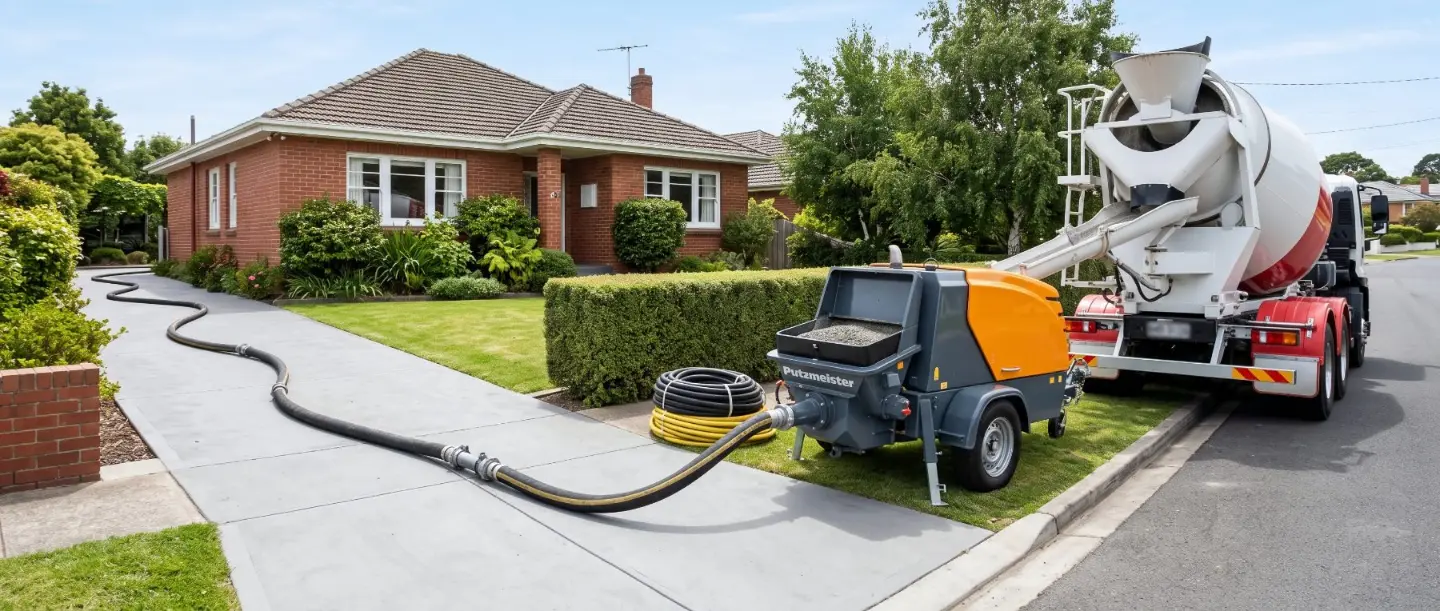
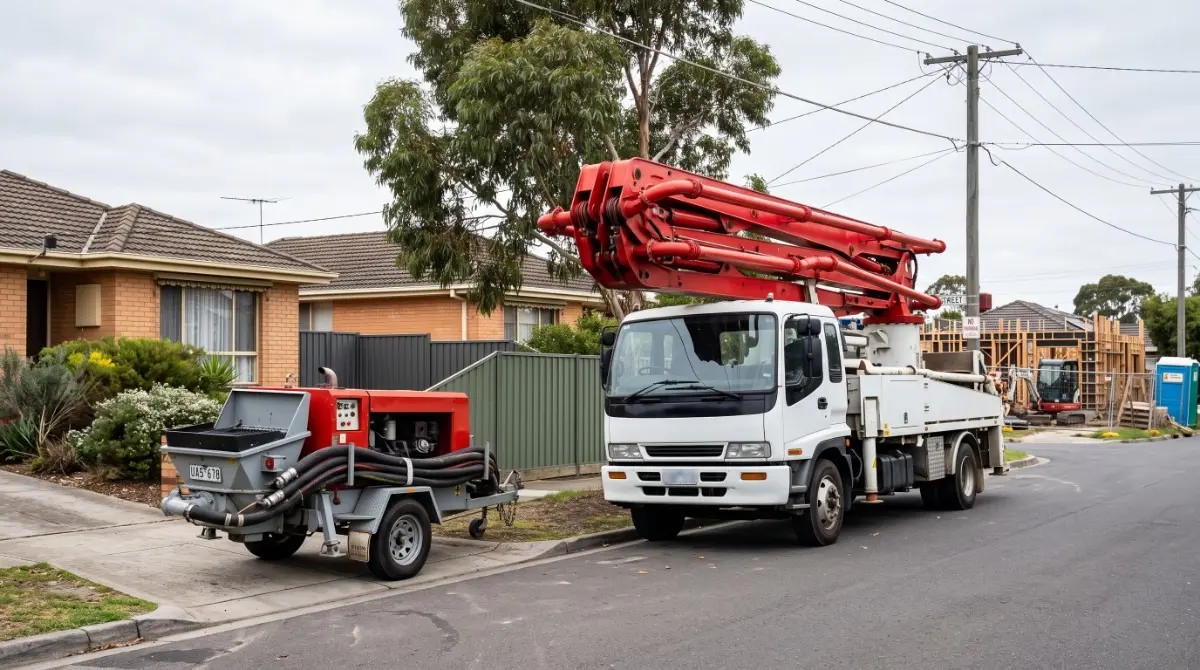
A compact trailer or truck-mounted pump that pushes concrete through a steel and rubber hose laid along the ground. It goes through side gates, down passages, around corners and under a house. Slower per cubic metre than a boom, and it is the right machine for perhaps nine out of ten back yards.
A truck with a folding articulated arm that lifts the hose up and over whatever is in the way, a house, a fence line, a retaining wall, a neighbour's carport. It places faster and it needs room on the street to put its outriggers down. This is the one people picture when they hear the word pump.
The chute on the back of the truck. Free, immediate and perfectly good for a front driveway or a shed pad the truck can reach. We will always check this first.
Which one your job needs is a question about access, not about budget. We look at the street, the gate, the levels and what the hose has to get past, and there is usually only one sensible answer.
Tell us the site and the volume and we will say which machine it needs, or whether it needs one at all.
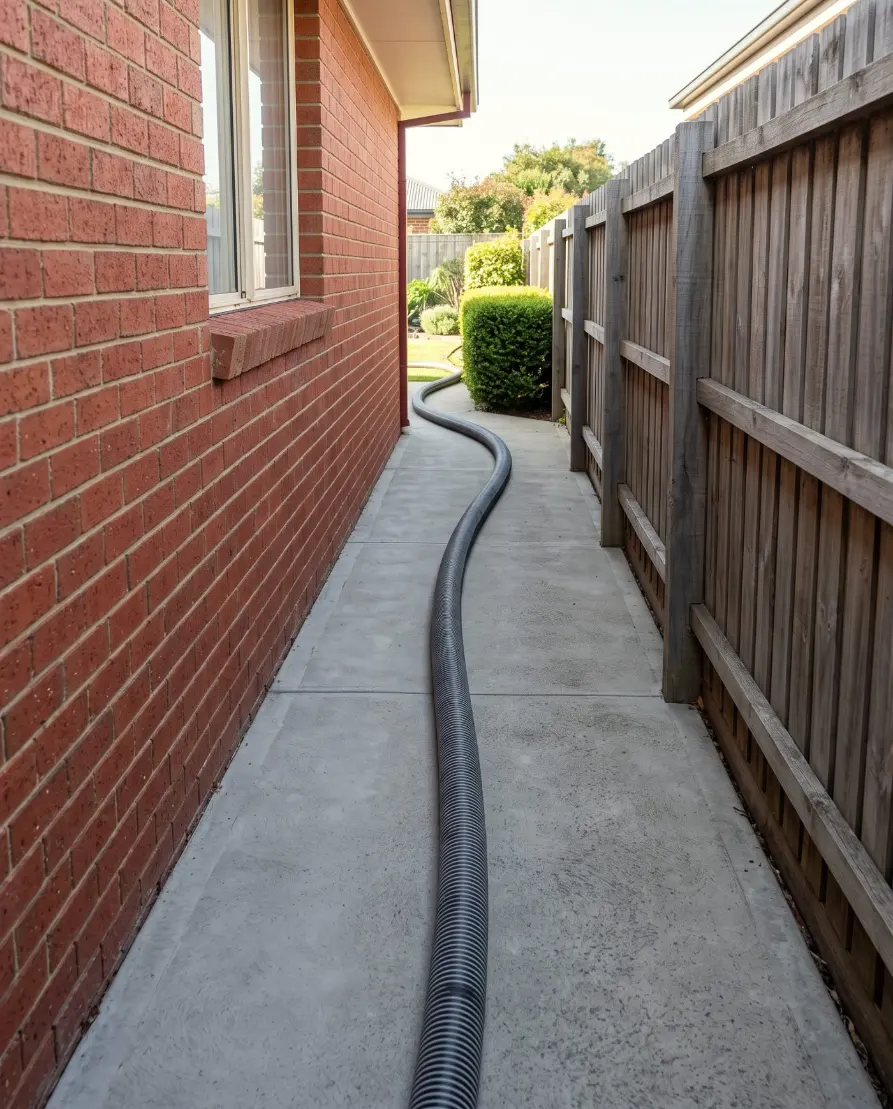
Most Launceston blocks are a house with a narrow gap down one side and the good part of the yard behind it. That gap is what decides the day.
It is roughly 75 to 125mm across and it needs room for someone to walk beside it. If a person fits down the side, the hose does too.
Every bend slows the flow slightly. It does not stop the job. It just means we plan the run rather than dragging hose and hoping.
Through a subfloor, under a deck, or through a garage and out the back door if that is genuinely the only route. It is not elegant and it works.
The pump does the lifting. A hose up onto a raised alfresco is nothing, where a barrow up the same steps is the hardest part of the day.
A locked rear boundary with no way through, or a passage full of stored timber and bikes. Both are solvable, and both are much easier to solve the week before.
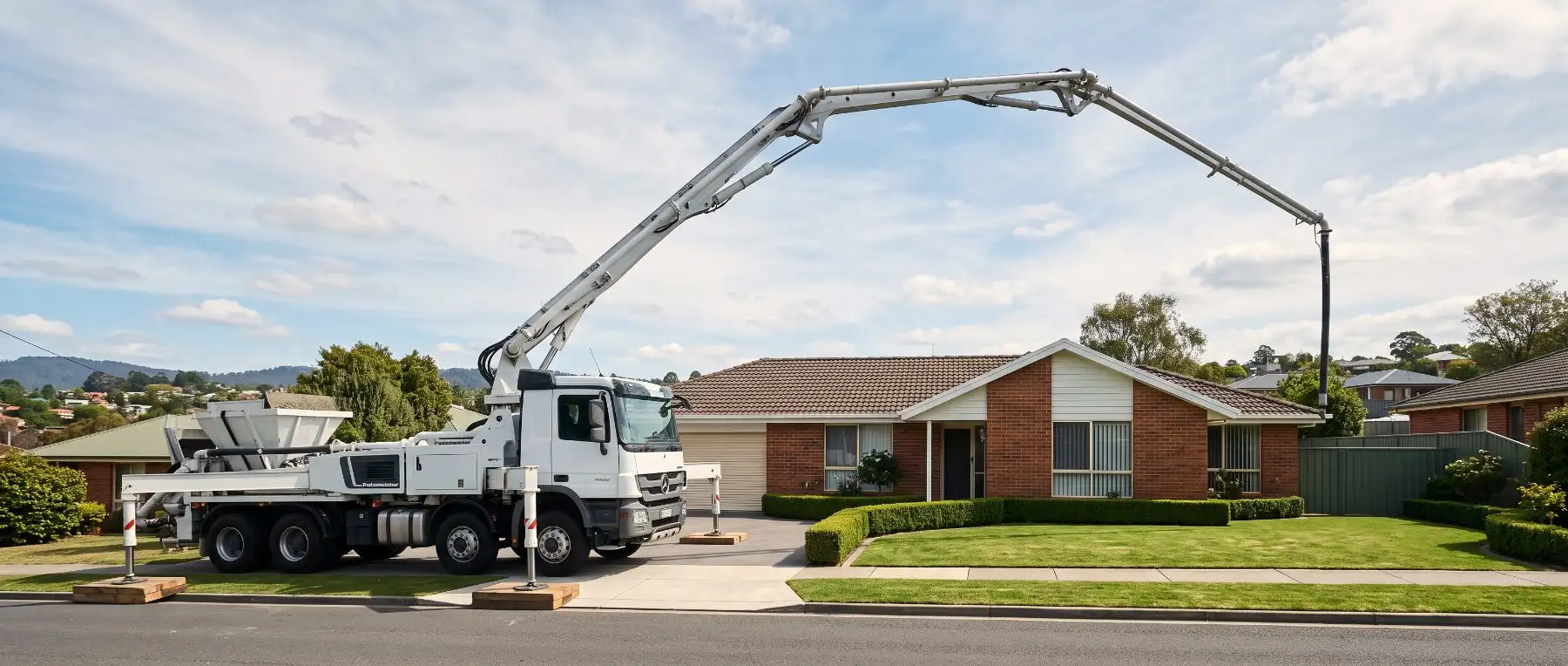
A boom lifts the hose clean over the house and drops it in the yard behind. Terraces, corner blocks, anywhere the side is built out to the boundary, and any job where the neighbour's property is the only thing between the truck and the pour. It needs a clear span on the street and a few minutes to set the outriggers, and then it places faster than anything else we own.
The honest version, with the case for doing nothing included. Read across.
Send us the address and we will look at the access on a map before we price it.
The specifications that decide whether your job is straightforward, in the plainest form we can put them.
Fits any gap a person can walk down
Further is possible, it just goes slower
Well over any single or double storey house
Front kerb to a rear boundary on most blocks
A typical 12m³ house slab in well under a day
Fast enough that finishing becomes the limit
Narrower than a standard side gate
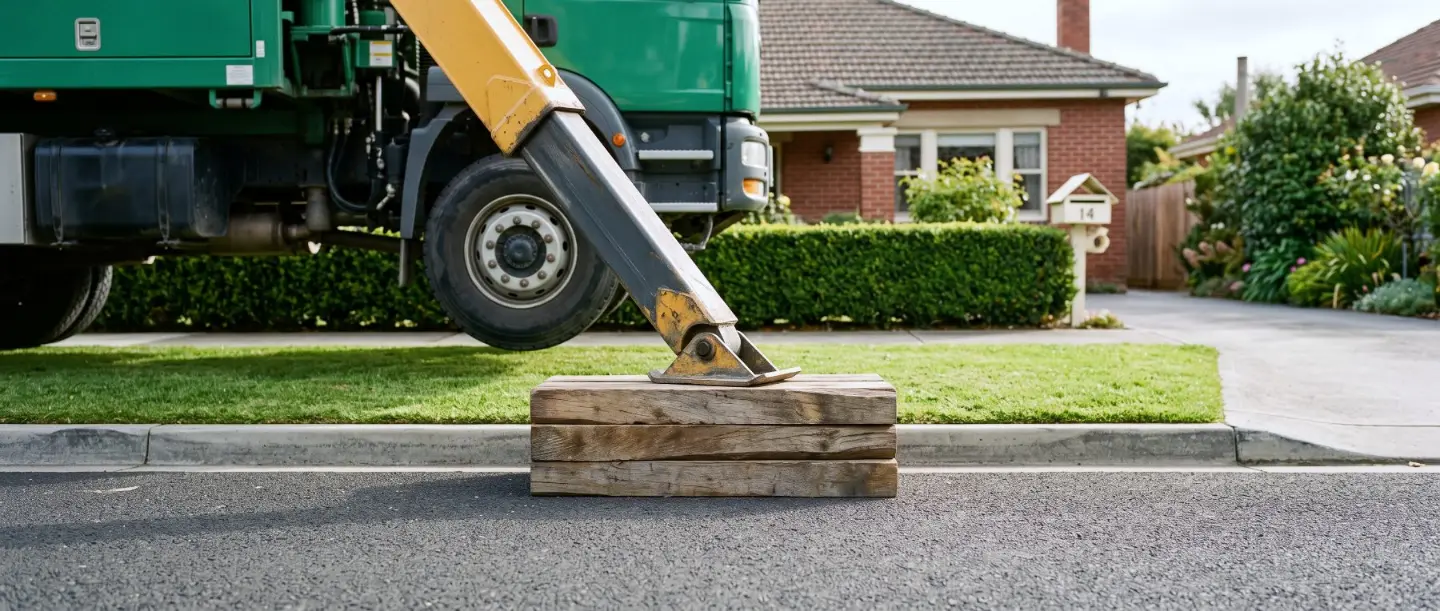
Outriggers down, usually one or two car spaces
Those are the working ranges rather than a promise about your block. We check reach and route on site before anything is booked, because a boom that cannot get its outriggers down is a truck that has driven out for nothing.
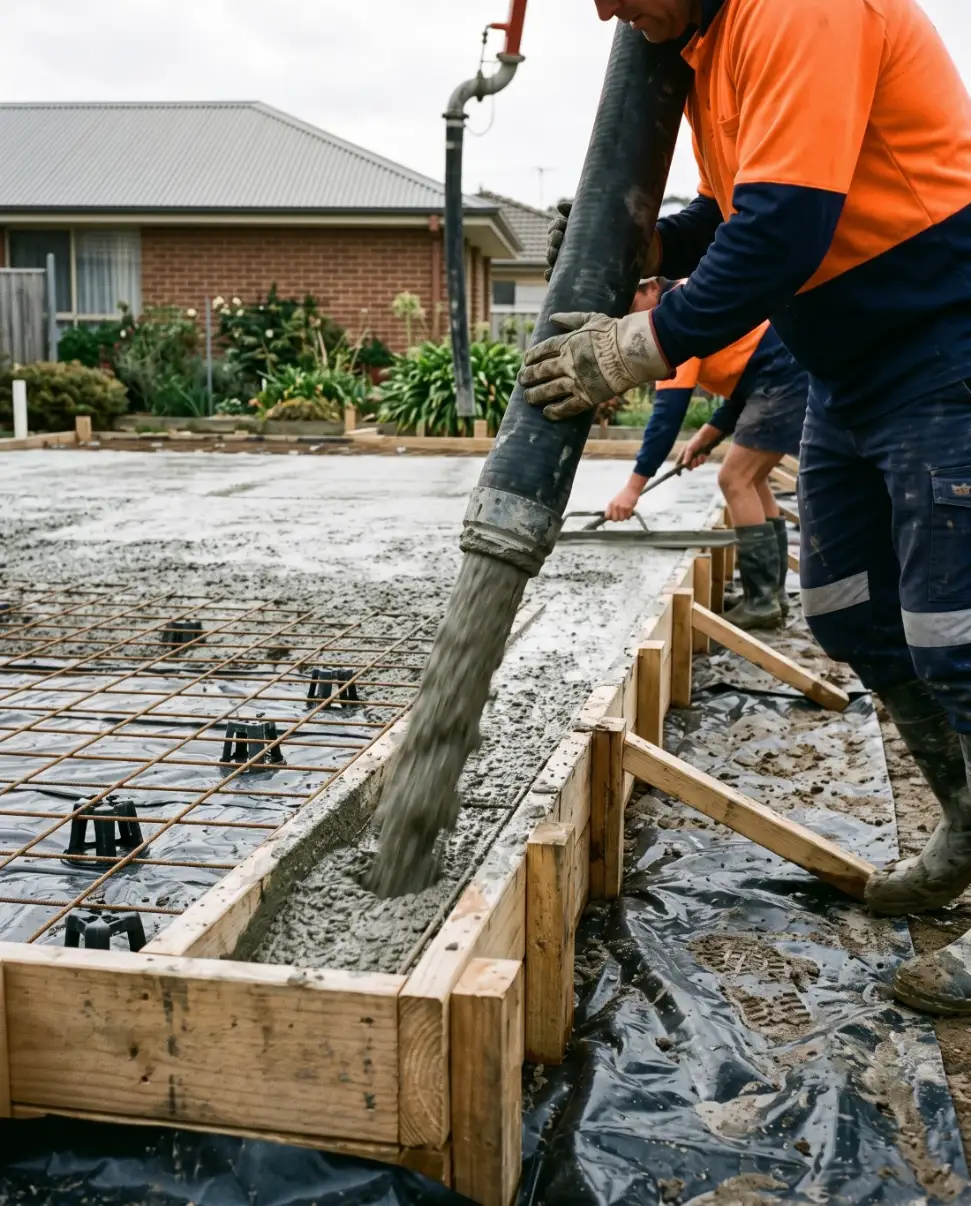
None of this is difficult, and all of it is much harder once there is a truck on the street and concrete going off in the drum.
Five steps, and the first one is the one that saves you money, because it is where we find out whether you need a pump at all.
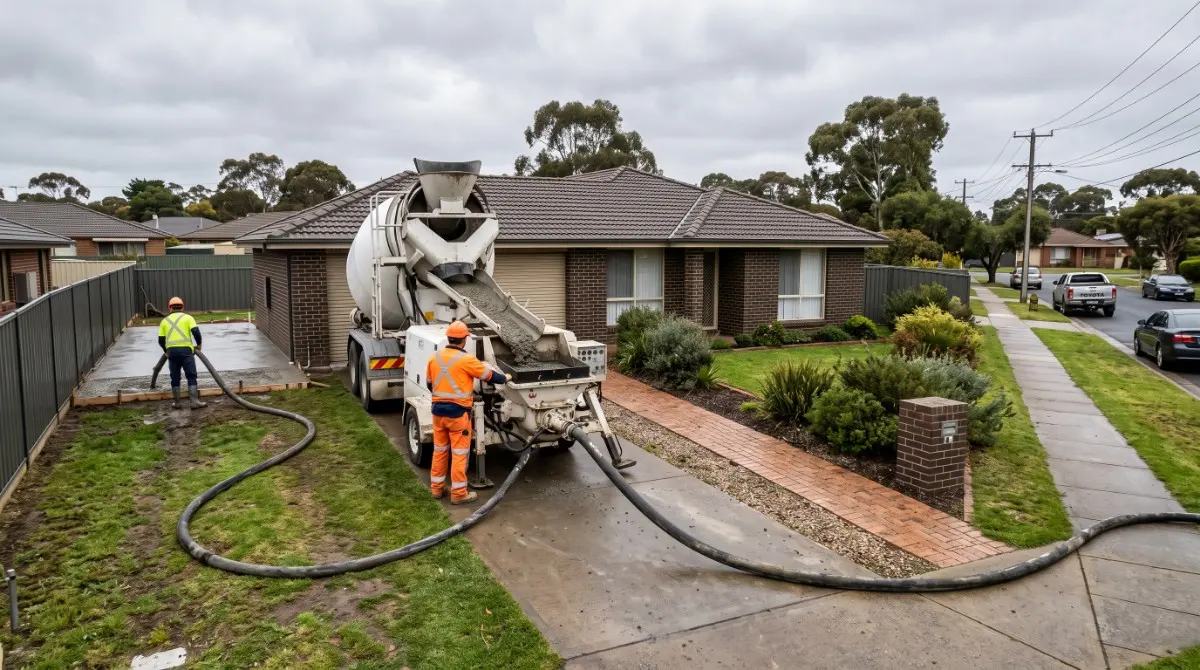
The street, the gate, the levels and what the hose has to get past. This is also where we tell you if the truck can just chute it and you can skip the pump.
Written, covering both, so you are not adding up two invoices afterwards to work out what a slab cost.
Pump positioned, outriggers on pads, hose run to the pour and pressure-tested before a single truck backs up.
Concrete straight from the truck to the formwork. We book the agitators in sequence so the pump is never standing there waiting on the next load.
The pump flushed somewhere sensible that we agree with you first, the hose packed, and the street left as we found it.
Pumping is priced off the machine, the setup and the time on site, and it is almost always quoted as part of the pour rather than on its own.
A line pump and a boom are different hire rates, and the difference is real. The access decides which one, so the access decides this line of the quote.
Volume sets how long the pump is standing there. A small pour is mostly setup and wash-out; a large one is mostly pumping.
Hose length and the number of bends. Twenty metres down a straight side passage is not the same job as eighty metres around a house and up a slope.
Running eighty metres of line through a house takes time before a single cubic metre moves. So does packing it up and washing it out.
A pump waiting on concrete is a pump you are paying for. We book the two together so that gap is ours to manage, not yours.
If we are pouring as well as pumping, it is one price for the job. A pump on its own for someone else's pour is priced differently.
Every quote we write covers the pump and the pour as one number. You should not be reconciling two invoices to find out what a slab cost.
There is no honest flat rate, because the price is driven by which machine your access needs, how much concrete is going through it, how far it has to travel and how long setup takes. A line pump into a back yard is a very different number from a boom over a double storey. We quote the pump and the pour together as one price, after we have looked at the site.
A line pump pushes concrete through a hose laid along the ground, so it goes through side gates and down narrow passages. A boom pump has a folding arm that lifts the hose up and over whatever is in the way, so it needs room on the street but it can reach over a house. Most residential jobs in Launceston go on a line pump.
Almost certainly. A line hose needs about 600 millimetres of clear route, which is narrower than a standard side gate, and it can run up to around 80 metres. If the side is built out to the boundary, a boom goes over the roof instead. The only genuine blockers are no route at all and a street with nowhere to stand a truck.
You can barrow almost anything, and sometimes you should. For a small pour with clear access we will tell you to skip the pump. Past about eight cubic metres, or anywhere there is a level change, barrowing stops being a saving. Concrete goes off on its own schedule and a slow placement shows in the finish.
About 600 millimetres for a line hose and someone to walk beside it. A boom pump needs roughly twelve metres of kerb to put its outriggers down, which is usually one or two car spaces, so it is worth telling the neighbours the day before.
Yes, and it is how we prefer to do it. When we book the concrete and the pump together, the gap between trucks is ours to manage rather than yours, and you get one price for the whole job instead of two invoices that have to be added up afterwards.
Most of this is settled in one phone call. Where the pour is, how far it is from where a truck can stand, and what is in the way. If you can send a photo from the street and one from the pour, better again.
One call and we come out, measure the real thing and put a price in writing. It costs nothing and there is no salesman in it.
One call. We measure it and put a fixed price in writing. Costs nothing.
Would rather type it out? Send the details instead